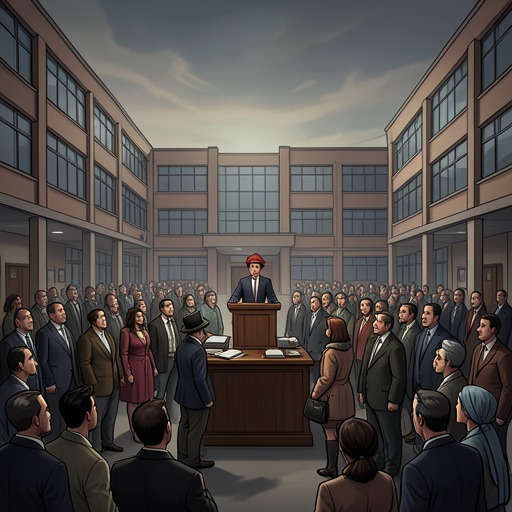
West Central Pennsylvania University’s budget and labor crisis
Straight ManWest Central Pennsylvania University’s budget and labor crisis makes threatened austerity both an administrative exercise and a contest over trust, allegiance, and who will bear the cost. A systemwide directive requires plans for a 20 percent reduction in staff and costs, though implementation is not guaranteed. Meanwhile, professors confront rumors of dismissal, departments wonder who may be placed on lists, and the faculty union weighs a strike whose timing could disrupt graduation. The crisis is defined as much by uncertainty and rumor as by the cuts being contemplated: the plans must be drawn up before anyone knows whether they will be carried out.
A hole in the ground and a budget in limbo
The crisis is foreshadowed by an excavation for a new College of Technical Careers building. Groundbreaking ceremonies had been delayed after the local congressman broke his ankle while disembarking from a charter plane; by the time the ceremony is rescheduled, the pit is already dug. The university has competed with other campuses for the project, which appears to promise investment and institutional favor. Yet the excavation also unsettles Hank Devereaux. He remembers that an earlier excavation preceded the unexpected appearance of a replica of his house, and the new hole prompts him to wonder what other surprises may follow.
That unease connects the physical project to rumors that professors will be purged. Hank reasons that administrators would hardly spend millions on a new facility while claiming financial hardship to dismiss tenured faculty. But he cannot rule out the possibility that the building will not be constructed after all, and the pit temporarily looks less like the foundation of a technical center than a mass grave for faculty. The competing interpretations capture the crisis’s unstable logic: construction suggests resources and confidence, while the excavation can also serve as an image of people being discarded.
Budget delays give that uncertainty practical force. Dickie Pope tells Hank that money has not reached the campus because each level of administration lacks its allocation: Dickie lacks his budget because Jacob Rose lacks his, and the chain extends to the chancellor while the legislature delays action. The chancellor expects a budget early the following week and promises that Dickie’s allocation should follow by the end of that week. Hank jokes that, at one duck a day, the delay would require only four or five more ducks to be killed. Dickie laughs, but Hank remains sober, underscoring the gap between a comic public threat and an unresolved resource problem.
The mandate to become lean and mean
Dickie presents the threatened reductions as a response to forces larger than any one campus executive. The chancellor has directed every campus executive officer to prepare a plan reducing staff and costs by 20 percent across the curriculum. Dickie emphasizes that drawing up a plan does not guarantee that it will be implemented. He nevertheless frames the directive as unavoidable: colleges that survive the decade, he argues, will be lean and mean, and changing enrollment demographics will force institutions to become more efficient.
The language of efficiency converts an uncertain mandate into an apparently natural transition. Hank pointedly questions how efficiency applies to education, while Dickie affirms that the university must change. He also casts the cuts as potentially beneficial: administrators will take the blame, the institution and students will supposedly win, and removing what he calls deadwood will benefit taxpayers. Dickie suggests Hank can participate without being made the public villain. Because the cuts are mandated from above, he argues, Hank would take less criticism than the administrators who execute them. The invitation offers Hank influence and protection at once, but depends on his accepting the premise that a reduction can be presented as institutional improvement.
Lists, retirement, and individual exposure
The abstract percentage becomes more threatening as faculty hear that departments may have names attached to the reductions. Tony Coniglia says he may be near the top of Dickie’s list because every person in biology has tenure and, as he understands it, one of them will have to go. He recalls that employees approaching their sixtieth birthdays were offered early-retirement incentives the previous summer. When he contacts personnel to say he might be interested, he learns that the offer is no longer available to him. He takes the withdrawal as a possible sign that the university is considering still more economical ways to reduce its workforce.
Tony also suspects that he lacks his dean’s unqualified support, connecting his professional vulnerability to the dean’s view that he has too much to offer women. He believes every department has a list and says he has heard as a fact that English has one. Hank asks whether Tony has heard that Hank drew it up; Tony has heard that there is a list, not that Hank made it. This distinction matters in a climate where suspicion can attach to the department chair even without proof of his authorship. Later, Paul Rourke tells Hank that the union has obtained a copy of the list and confirms that it includes every department, including English. What had been a rumor about targeted faculty thus becomes a piece of information circulating between opposing sides, though the evidence does not establish who prepared each department’s names or which proposed cuts will take effect.
Competing claims on Hank
The crisis places Hank between university administrators and colleagues organizing through the union. Herbert Schonberg tells him that the union wants him on its side because it is the right side and because he could be its point man. Hank’s public composure on television, together with English’s large number of votes, could help rally faculty. Herbert says that Teddy Barnes and June Barnes have sided with Paul Rourke and Finny, a break with their usual alignments that signals how much the conflict has shifted departmental loyalties.
Beneath Herbert’s appeal is a warning: Hank’s department and friends may already be organizing against the administrative course he is being asked to support. Herbert presses him to declare where he stands, presenting the choice as one between joining the union’s fight and making friends with Dickie. Hank asks whether he can reject both camps. Herbert calls neutrality dangerous, arguing that a person without allies is vulnerable. Dickie’s earlier approach makes the opposing offer: Hank can help shape the reductions, save friends, and avoid taking the blame that administrators expect to absorb. Neither appeal is merely procedural. Each side tries to turn Hank’s standing among colleagues into leverage, and each describes allegiance as both a moral choice and a means of survival.
Strike threat and its outcome
The union’s leverage takes a particularly consequential form when Herbert calls for a strike vote with only a week left in the term. The stated purpose is to prevent seniors from graduating, using disruption to exert pressure at a moment when the university has little time to respond. The tactic demonstrates the union’s capacity to make the labor dispute affect students directly; it also exposes the costs of turning the academic calendar into bargaining leverage. Faculty support cannot be assumed simply because the union calls for action, especially when departments and individuals differ in their exposure to cuts.
The eventual vote goes overwhelmingly against a strike. According to The Rear View, faculty make that decision after Dickie Pope has been dismissed and Jacob Rose, whom they have known and respected for years, becomes the new chief executive officer. Their choice rejects the position urged by their own union and runs against the interests of faculty such as Finny who would be directly affected by the following year’s budget cuts. The leadership change therefore changes the political conditions of the dispute: Jacob’s appointment offers faculty a familiar figure at the top, while Dickie’s dismissal marks a sharp institutional reversal. The vote does not erase the coming cuts or establish that the reduction plan will be implemented. Instead, it records a decisive limit on collective action at the point when the potential consequences for vulnerable faculty remain immediate.
Institutional conflict and its human measure
The university’s crisis is sustained by the distance between a quantified mandate and the lives that numbers may affect. Administrators speak in percentages, efficiency, and systemwide plans; faculty encounter disappearing retirement offers, circulating lists, uncertain departmental budgets, and a strike vote that could keep seniors from graduating. The planned technical building sharpens the contradiction: visible construction can suggest prosperity even while administrators prepare for staff and cost reductions. In that sense, the excavated site is not proof that the purge rumors are false, nor proof that cuts are inevitable. It is a material sign around which competing interpretations gather.
The conflict also shows how budget policy reorganizes relationships before any final list of layoffs is established. Dickie recruits Hank by promising that he can help decide who is saved; Herbert recruits him by invoking solidarity and the right side. Tony’s fears and Paul’s disclosure of the union’s copy make the lists tangible, while the failed strike vote reveals that a shared threat does not produce a unified faculty response. The crisis remains unresolved as a matter of staffing and costs, but its institutional effects are already visible in the competing alliances and the decision not to strike.